News
View the latest inspiring and positive news and information about what's going on in the PM and IT world.
Why choose E-learning?
Professional development does not have to disrupt your schedule. Our E-learning courses are designed to fit around your work and personal commitments, making it easier than ever to achieve your certification goals.- Flexible learning: study whenever and wherever suits you best
- Short learning moments: make progress, even with a busy agenda
- Trainer support: guidance from experienced professionals throughout your learning journey
- Certification preparation: prepare for internationally recognised certifications
- 12 months access: learn and revisit materials at your own pace
Give your career a boost
The certification you earn today can create opportunities tomorrow. By investing a few hours each week in your professional development, you can strengthen your expertise, increase your confidence, and be ready for new projects, responsibilities, and career opportunities in the months ahead. With the summer period just around the corner, many professionals find themselves with a little more flexibility in their schedules. Why not use that time to earn the certification your future self will thank you for?Make this opportunity count, now
This campaign is available for a limited time only. Explore our e-learning courses and choose the certification that will help you reach your next professional milestone. Start today.
ITIL (Version 5) launches today, representing the newest version of the world’s leading IT Service Management framework. This launch is timed to support organisations navigating unprecedented digital transformation. ITIL (Version 5) moves beyond traditional Service Management paradigms while firmly retaining the foundational cornerstones of effective Service Management.
Key innovations in New ITIL
The new ITIL has been specifically engineered to thrive in today’s fast-changing, AI-driven environment. It offers practical, role-relevant guidance designed to help professionals and organisations consistently deliver measurable value.
ITIL (Version 5) is characterized by:
- Modern, integrated and comprehensive design: ITIL (Version 5) helps teams collaborate more effectively, align priorities and create value consistently.
- AI-native and practical by design: ITIL (Version 5) provides clear, practical guidance for adapting ways of working, making informed decisions and responding to change as technology, business needs and customer expectations evolve.
- End-to-end lifecycle for digital products and services: ITIL (Version 5) helps teams design, deliver and improve digital products and services with greater visibility, stronger collaboration and a clearer understanding of how different stakeholders experience value.
Breaking silos with integrated lifecycles
ITIL (Version 5) tackles one of the biggest challenges organisations face today: disconnected product and service teams. Traditionally, developing a digital product and managing it as a live service were treated as separate, linear activities—often causing delays, miscommunication, and inefficiencies. The new ITIL 5 breaks down these silos with a fully integrated, end-to-end lifecycle, spanning discovery, design, building, testing, transition, operation, delivery, and support.
The result? Faster value delivery, fewer errors, and smoother collaboration across teams. By sharing responsibility for outcomes, organisations can respond more effectively to change, align technology with business priorities, and ensure that every release, deployment, and improvement delivers measurable value.
In short, ITIL (Version 5) does not just update processes—it reshapes how digital products and services are created, managed, and improved in today’s fast-moving, AI-driven world.
Why the new ITIL
When the environment changes the framework needs to adapt accordingly, in order to remain relevant. The main reasons why there is a new ITIL in 2026 are:
- A new digital landscape
- Digital first business models
- The AI revolution
- Greater adaptability
- Stronger interconnection and value focus
- A simpler, clearer qualification scheme
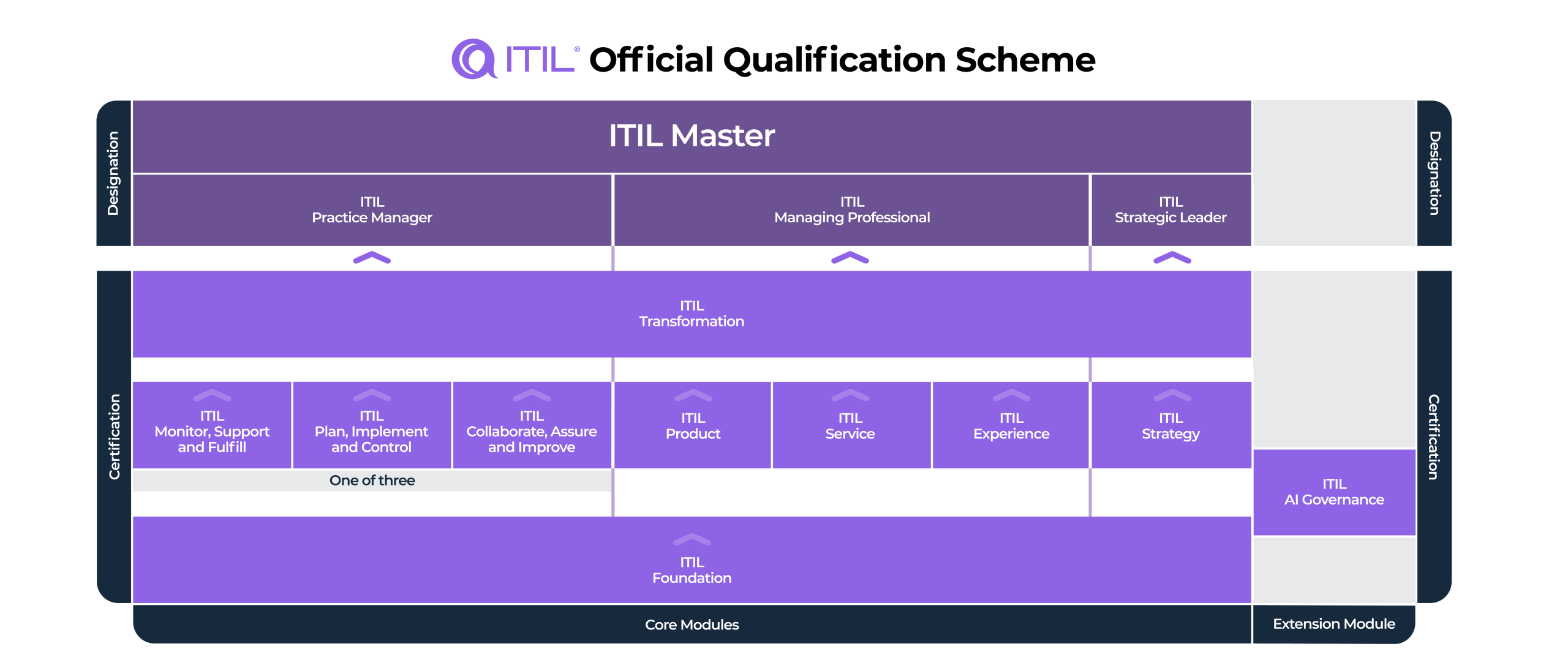
ITIL (Version 5) Official Qualification Scheme
In ITIL (Version 5) the qualification scheme begins with the ITIL Foundation and continues with eight upper-level modules and one extension module.
The ITIL (Version 5) qualification scheme diagram below provides a visual overview of how the certifications and designations fit together and how candidates can progress through the framework.
If you already hold an ITIL 4 Foundation certification—or any ITIL 4 certificate—you do not need to retake Foundation to progress to ITIL (Version 5) upper-level modules. ITIL (Version 5) builds on ITIL 4, and your existing qualifications are fully recognized as prerequisites.
For a quick update on the key changes at Foundation level, you can take the one-day ITIL (Version 5) Foundation Bridge course, which includes a short exam and awards the ITIL (Version 5) Foundation certificate.
From there, you can continue your ITIL journey by selecting the upper-level modules that best align with your role and career goals, leveraging your ITIL 4 experience to connect established best practices with the latest guidance on digital product and service management.
Recently, the Project Management Institute has published the PMBOK® Eighth Edition, a purposefully more practical, evidence-based update to the profession’s reference Guide. This is not a small tweak, it is the most community-informed edition PMI has produced and it brings a clearer bridge between why we run projects, what we do, and how teams should work in today’s context.
PMBOK 8: What Has Changed
The PMBOK® Eighth Edition significantly updates the project management profession, emphasizing value delivery, performance domains, and broad applicability. It includes:
- Six core principles that guide effective project management behaviour
- Seven performance domains that represent key areas of practice
- Reintroduced processes as flexible, non-prescriptive anchors that operate across predictive, adaptive and hybrid approaches to support the performance domains
- Expanded coverage of AI, PMOs, value and sustainability: the Guide now explicitly integrates guidance on value delivery and on technologies and ways of working that matter in modern projects
- Inputs, Outputs, and Tools & Techniques now appear as non-prescriptive items, covering various approaches and referenced across the Guide.
The Practical Implications for Project Managers
The Eighth Edition shifts the conversation from activity-focused metrics to outcome-focused judgement: success is no longer measured only by whether scope, schedule and budget were met, but by whether the value delivered outweighs the effort and expense invested. That subtle reframing pushes organisations to align project activity with strategic outcomes, encouraging teams and sponsors to prioritise benefits and business impact over purely transactional milestones.
PMBOK 8: More Flexibility, Better Results
At the same time, PMBOK 8 gives practitioners the best of both worlds — principled, performance-domain thinking paired with practical “how-to” guidance. The Guide restores process-level guidance, but presents it as flexible, non-prescriptive reference material rather than prescriptive rules. The renewed perspective gives back the “how” to practitioners. This makes it easier for teams operating in predictive, Agile or hybrid environments to adopt patterns that fit their context while keeping a consistent language for governance and stakeholder communication.
The edition also brings urgent, contemporary topics into the core of project practice: explicit guidance on AI with PMI’s new course CPMAI, sustainability, quality integration, PMOs and procurement helps organisations address risks and opportunities they increasingly face. Finally, because the update was shaped by thousands of practitioners, the guidance is more evidence-informed and grounded in what works in real projects: reducing the gap between theory and practice and improving the immediate applicability of the recommendations
Our perspective as Accredited Training Organisation (ATO)
As an external organisation reporting to and serving the project-management community, we welcome PMBOK® 8. It brings a pragmatic balance: sharpening principle-based thinking while returning useful, practical process guidance — and doing so on the backbone of unprecedented practitioner input. For teams focused on delivering measurable business outcomes, this edition provides clearer language and a more contemporary toolkit to navigate value, quality, AI and sustainability considerations..
The updated PMBoK 8 will be integrated in QRP International’s PMP courses in 2026!
Discover our PMP course and certification, and continue your professional development journey with QRP, your partner in continuous learning.

The Comitato Maria Letizia Verga
Founded in 1979 by Giovanni Verga, the father of Maria Letizia, the Comitato Maria Letizia Verga is an association that unites parents, volunteers, friends, supporters, researchers, doctors, and healthcare professionals in an Alliance with a shared mission: to improve the overall quality of life of children and adolescents affected by hematological malignancies diseases, as well as complex therapeutic, metabolic, and genetic conditions. For over 45 years, the Comitato has led numerous initiatives to study and treat childhood leukemia, providing care and treatment to over 2,500 children and adolescents. Thanks to its efforts, the recovery rate has significantly increased — from 30% in 1979 to 85% today. In particular, the Comitato Maria Letizia Verga has:- Invested over €120 million in research, treatment, and patient care;
- Established the Maria Letizia Verga Center, an integrated system designed to address the complex needs of children with leukemia and their families. Located within the IRCCS San Gerardo dei Tintori Foundation, it combines research, treatment, therapy, and support services;
- Built the Maria Letizia Verga Residence, providing accommodation for children and adolescents undergoing treatment at the Center, along with their families;
- Promoted the creation of the Tettamanti Research Center and the Monza and Brianza Foundation for Children and Mothers;
- Established the Stefano Verri Cell and Gene Therapy Laboratory, a cell factory inaugurated in 2003 in collaboration with the Tettamanti Foundation and the Stefano Verri Committee.
CISA Certification
The CISA certification enhances credibility by equipping professionals with advanced auditing skills, to safeguard information systems in today’s cyber landscape. Protecting data and strengthening organisations against cyber threats is key in our modern world. Our Certified Information Systems Auditor training offers a globally recognised certification.CISM Certification
The CISM certification is crafted for IT professionals ready to lead in governance, risk management and incident response. The Certified Information Security Manager training covers 4 domains:- Information Security Governance
- Information Security Risk Management
- Programme Development
- Incident Management
Why the CISA or CISM Training could be relevant for you?
Together, these certifications help individuals develop the skills needed to protect information assets, manage risks, and ensure the confidentiality, integrity, and availability of critical data. Research shows that 70% of professionals certified in CISA and CISM report improved on-the-job performance, highlighting the value of these credentials in today’s evolving IT landscape. As an Accredited Training Organisation (ATO) for ISACA, QRP International offers flexible training formats tailored to meet individual and team needs. Take the next step in your career: join QRP International’s CISA and/or CISM courses and become a leader in information security management! Discover our CISA and CISM courses here!